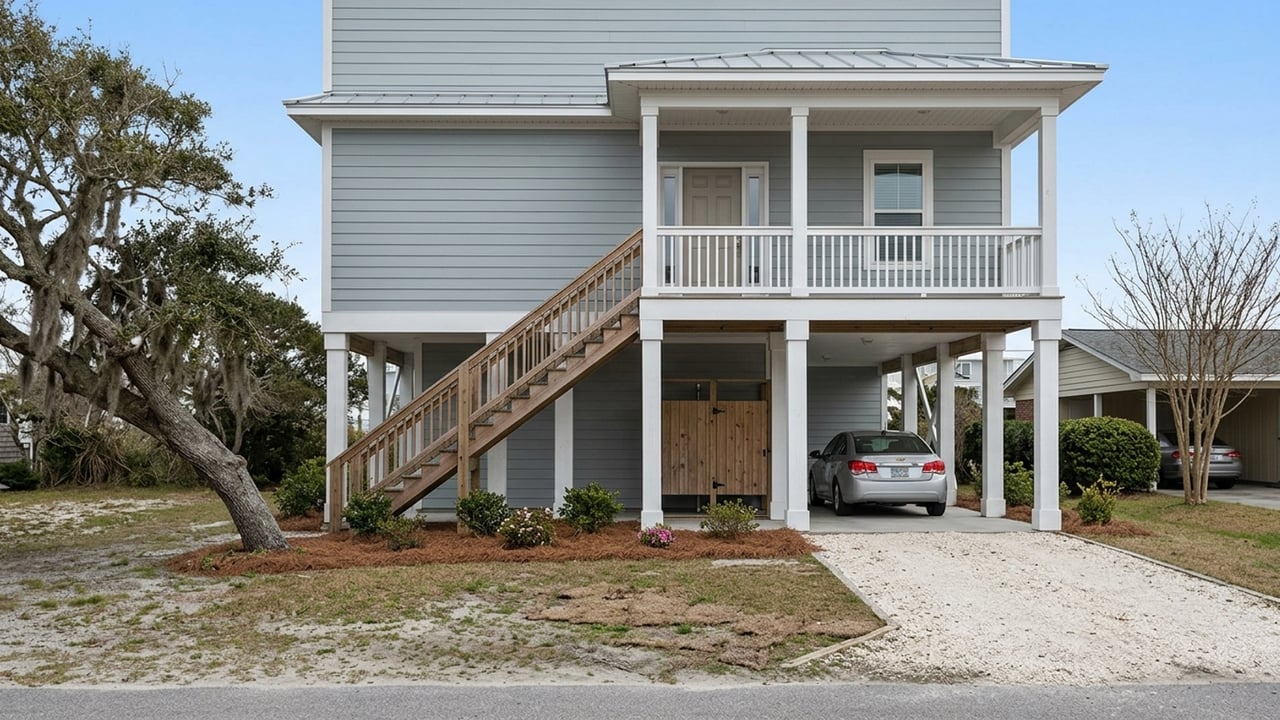
Property Taxes in Oak Island, NC: Your 2026 Rates and Payment Guide
Marc Stollings October 9, 2026
Marc Stollings October 9, 2026
Oak Island, NC draws buyers who want coastal living, and the carrying costs deserve just as much attention as the listing price. The median sale price for an Oak Island home runs around $609,347, with homes sitting on the Oak Island housing market for roughly 87 days. Those numbers set the stage, but your actual monthly cost depends on what you'll owe in property taxes every year.
Whether you're buying a primary residence or a vacation rental, that tax bill is real money. Brunswick County handles assessment and collection for the town, so you're dealing with one consolidated structure rather than two separate bureaucracies.
For Fiscal Year 2025-2026, the combined effective property tax rate in Oak Island is 54.20 cents per $100 of assessed value. That total is Brunswick County's countywide ad valorem rate of 34.20 cents per $100, plus the Town of Oak Island's municipal rate of 20 cents per $100.
The town's 20-cent piece isn't a lump sum - it breaks into specific funding areas: 10 cents goes to the general fund, 7 cents covers the fire tax, and 3 cents supports the sand fund. Starting with the 2026 tax bills, Brunswick County bills and collects both the county and municipal portions together in one statement.
Every property owner in Oak Island pays the baseline 34.20-cent county rate. The additional 20-cent town rate applies only to properties inside the municipal limits, covering local services like beach maintenance and fire protection.
Buyers looking at unincorporated areas of the county skip the municipal tax - but they also don't receive town services. Oak Island's total rate holds up competitively against other coastal municipalities offering similar infrastructure.
The most noticeable shift this year is the billing consolidation. Instead of separate notices from the town and the county, you now get one combined bill from the Brunswick County Tax Office. If you're paying through an escrow account, make sure your lender has updated their records to reflect this unified collection method.
North Carolina expresses its tax rate in cents per $100 of assessed value, not the percentage-based mill rate you'd see in other states. The math is straightforward: divide your home's assessed value by 100, then multiply by the combined rate.
The Brunswick County Tax Office determines your assessed value through periodic countywide revaluations. That figure is the baseline for both your county and town obligations, and it stays fixed until the next official revaluation - market swings don't change it in the interim.
Assessed value and market value are not the same number. Recent sales show Oak Island homes trading around $609,000, but the county taxes you on the value established during the most recent official assessment period - not what the market is doing today.
Zillow's Home Value Index puts the typical Oak Island home value at roughly $555,572, which is a reasonable starting point for estimating taxes when you don't have the exact assessed figure in hand.
Using that typical home value of $555,572: divide by 100 to get 5,555.72, then multiply by the combined effective rate of 54.20 cents (0.5420). You land at an estimated annual property tax bill of roughly $3,011 for a typical home within the town limits.
Buyers shopping in the 28465 ZIP code can get a ballpark by applying the 54.20-cent rate to the listing price or a recent appraisal. It's a conservative estimate - the actual bill depends entirely on the county's official assessment on file.
If a property hasn't been reassessed recently, the current owner's tax bill might run lower than what you'll eventually pay after the next countywide revaluation. Build that potential increase into your long-term budget now rather than being surprised later.
A home assessed at $400,000 works out to an annual tax of $2,168 under the current 2025-2026 rate. A higher-end property assessed at $800,000 generates a bill of $4,336 - which adds about $361 per month to your escrow requirement.
For a specific property, the most accurate move is to pull its current assessed value directly from the county. Brunswick County provides public access through its online tax portal. Searching by address or parcel number shows you the exact assessed value, the land-versus-improvement breakdown, and the historical tax amounts the current owner has paid.
Beyond property taxes, purchases within Oak Island are subject to a combined sales tax rate of 6.75%. This applies to most tangible goods bought within the town limits. Oak Island itself doesn't add any municipal sales tax on top of what the state and county already require.
The 6.75% total comes from two pieces: North Carolina's state sales tax rate of 4.75% and Brunswick County's local rate of 2.00%. That's the full picture - nothing more gets stacked on at the town level.
If you're buying supplies for a renovation or furnishing a vacation rental in the 28465 ZIP code, you'll pay that 6.75% rate. Food and certain groceries fall under different, lower tax rules under North Carolina state law. Because the town adds no local surcharge, shopping in Oak Island costs the same in sales tax as shopping in the unincorporated parts of Brunswick County.
The Brunswick County Tax Office manages all appraisal, assessment, and collection for Oak Island properties. They're your primary contact for any questions about your balance or payment history, and you can reach them through brunswickcountync.gov/447/Tax-Office.
You can look up your bill at tax.brunsco.net/itsnet/BasicSearch.aspx, searching by owner name, address, or parcel identification number. These records are public in North Carolina, so if you're a buyer considering a property, you can verify past taxes and confirm there are no delinquent balances attached before you close.
Tax bills typically arrive in late summer and are due September 1, though you have until early January of the following year to pay without interest or penalties. You can pay online through the Brunswick County portal, mail a check to the tax office, or go in person. If you have a mortgage, your lender will most likely handle the disbursement directly from your escrow account.
North Carolina has several programs that can reduce a property owner's tax burden by lowering the taxable assessed value. Not everyone qualifies - you'll need to meet specific age, income, or disability requirements. The Brunswick County Tax Office administers all of these programs and handles the applications.
The state offers a property tax relief program for qualifying seniors over 65 and totally disabled individuals, excluding a portion of the home's assessed value from taxation if the owner meets state-set income limits.
There's also a disabled veteran exclusion. Veterans with a 100% total and permanent service-connected disability can receive a reduction in their property's assessed value, and this particular program carries no income limit.
If you think the county has overvalued your property, you can appeal - and these appeals tend to land best immediately following a countywide revaluation. You'll need evidence that the assessed value exceeds the actual market value at the time of that revaluation: a recent appraisal, comparable sales data, or documentation of property defects all support the case.
A newly built home introduces some tax variables that a resale property doesn't. The initial bill on new construction may not reflect the finished value of the home, because assessors value properties based on their status on January 1 of the tax year. A partially complete home on that date means the bill covers only the land and the incomplete structure.
Once the home is finished, the county assesses the completed structure for the following tax year. That means buyers of new construction should expect the property tax bill to increase in year two. Escrow accounts on new builds often run short because lenders initially calculate payments based on the unimproved lot value - set funds aside to cover the jump when the finished house gets assessed.
Some neighborhoods carry special assessments on top of the standard rate - additional charges tied to specific infrastructure projects like sewer extensions, road paving, or beach nourishment. These are separate from the 54.20-cent ad valorem rate. Review the seller's disclosures and title work carefully to catch any outstanding special assessment balances before you close.
Property taxes vary considerably across Brunswick County depending on which municipality you're in. Every incorporated town sets its own rate on top of the base county rate of 34.20 cents, and those municipal add-ons range widely. Oak Island's 20-cent municipal rate puts it squarely in the middle of the local spectrum.
Towns with dedicated police forces, extensive municipal services, and large-scale infrastructure commitments tend to carry higher local tax rates - more services require more revenue. Buyers looking at larger coastal towns in the region will find that total effective rates can exceed Oak Island's.
The lowest property taxes in the area belong to unincorporated Brunswick County. Properties outside any town limits pay only the 34.20-cent county rate, plus any applicable fire district fees. Lower bills, yes - but no municipal services like town-maintained beach accesses, local zoning enforcement, or municipal trash collection.
For Fiscal Year 2025-2026, the combined effective property tax rate in Oak Island is 54.20 cents per $100 of assessed value. This includes Brunswick County's rate of 34.20 cents and the town's rate of 20 cents.
Using Zillow's typical home value of $555,572, the estimated annual property tax is roughly $3,011. This is calculated by dividing the value by 100 and multiplying by the 54.20-cent combined rate.
You can look up and pay your bill online at tax.brunsco.net/itsnet/BasicSearch.aspx. The Brunswick County Tax Office handles all collections for both the county and the town of Oak Island.
Property taxes in North Carolina are due on September 1 of each year. Owners have until early January of the following year to pay the balance before interest and penalties accrue.
Seniors don't automatically stop paying property taxes at a certain age. Residents over 65 who meet specific state income limits can apply for a property tax relief program that excludes a portion of their home's assessed value from taxation.
The lowest property taxes are found in the unincorporated areas of Brunswick County, where owners pay only the 34.20-cent base county rate plus local fire district fees. Incorporated towns with extensive services and infrastructure carry higher combined rates.
New construction is taxed based on its completion status on January 1, so the first tax bill often reflects only the lot and a partial build. Special assessments are separate, additional charges for specific infrastructure projects like sewer lines or road paving, billed on top of the standard ad valorem tax rate.
Stay up to date on the latest real estate trends.

With 39 closed transactions and a deep understanding of coastal investment properties, Marc Stollings provides fact-based guidance as the best real estate agent in Oak… Read more
Partner with a trusted local expert to navigate the Oak Island real estate market with confidence, personalized service, and proven results.